
A Lehigh ADVANCE Approach to Mentoring & Professional Development
"Mentorship is a professional, working alliance in which individuals work together over time to support the personal and professional growth, development, and success of the relational partners through the provision of career and psychosocial support." -- NASEM, 2019 Consensus Report: The Science of Effective Mentorship in STEMM
"A reciprocal learning relationship characterized by trust, respect, and commitment in which a mentor supports the professional and personal development of another by sharing life experiences, influence, and expertise." - Zellers, Howard, Barcic, 2008
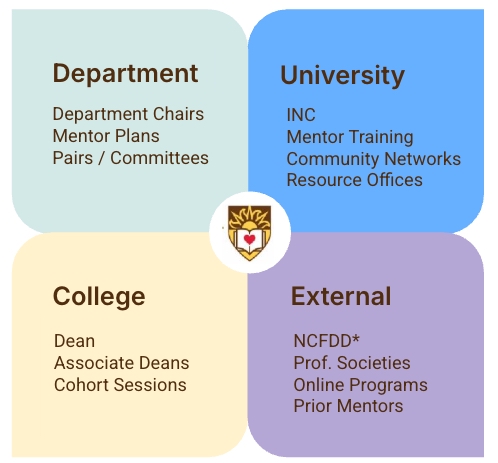
 Faculty at Lehigh University have access to mentoring throughout their professional journey, drawing support from a variety of individuals, groups, and programs across different organizational levels. By default, new faculty can receive mentorship through their departments and through the Interdisciplinary Networking Mentorship happens through both formal and informal activities. Mentoring relationships can form via a program and also through participation in network groups, research centers, communities of practice, or other forms of engagement.
Lehigh ADVANCE Center for Faculty Development and Success endorses building a diverse mentor network, not only a single mentor within a dyadic pairing. Mentoring is different from evaluation and supervision, though evaluation may come with advice, and supervisors may sometimes be mentors. The skills and attributes of high quality, effective mentorships can be developed and refined over a career. Faculty are frequently mentors and mentees at the same time. Surround yourself with:
- People who help you get the job done
- People who help you advance your career
People who provide personal support for you
The university offers several formal programs for specific groups of faculty which complement, and don’t replace, mentoring within a faculty member’s department or college. You can find a full menu of Professional Development Programs, including Mentoring, Leadership at this table.
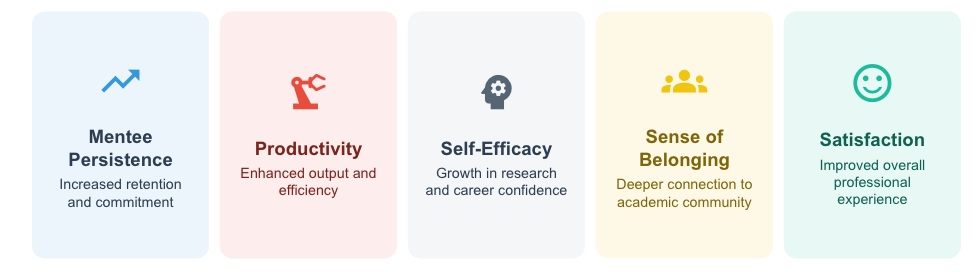
Mentoring programs organized by the ADVANCE Center keep inclusive excellence in mind, recognizing that historic mentoring approaches do not always work for all the faculty working in universities today. We offer mentoring programs and trainings because mentoring that attends to systems and best practices will cultivate a culture of mentoring which benefits individuals and organizations. ADVANCE has the capacity to support departments and/or colleges to design and assess their own faculty-faculty mentoring efforts.
Characteristics of Mentoring
Mentoring involves
- Advising, but not only advising
- Giving feedback
- Role modeling
- Coaching
- Curiosity & cultural awareness
Mentoring is not
- Evaluation or performance review
- Imprinting or cloning
- Supervision or management
- Asking to trade or mask parts of self to belong
Mentoring Programs and Resources
- ADVANCE LU-WISE: Community for and about STEM women faculty and their allies
- Gender, Leadership and Empowerment: Lehigh Women's Network, Lehigh Parenting and Caregivers Network
- Women of Color Conversations: Community conversations for and with women of color and their allies
- Faculty and Staff of Pride Network
- Faculty and Staff of Color Network
- International Faculty and Staff Network- A home for those with global roots— whether you are a non-citizen, have lived abroad, or share a home with an international spouse.
- National Postdoc Association
Lehigh ADVANCE Mentoring Guide Basic Agreement
Lehigh ADVANCE: Faculty Development Planning Detailed Reflection Questions (part of promotion plan and useful at all career stages)
After the NSF required mentoring plans, we organized this resource list
University Program: Interdisciplinary Networking Committee program. The Interdiscilnary Networking Committee program is for any new faculty who wishes for a networked mixed mentor-peer model of learning the institution and building connections.
Your Mentor Network Map (adapted from WEBS 2011 Workshop materials
Establish your own faculty development plan. Core questions for self reflection as you establish your new faculy career can help guide and inform time management and saying yes or no to different opportunities.
How to be a "Quick Starter"- (Adapted from R. Boice, Advice for New Faculty Members, Needham Heights, MA: Allyn & Bacon, 2000)
Approximately 95% of new faculty take 4 to 5 years to meet their institution's teaching and research expectations
The other 5% - the “quick starters” - achieve this in the first 2 years of their appointment- How to be a quick starter?
- Schedule a time for writing on a daily basis and actually use that time to write--Most new faculty talk a lot about the importance of scholarly writing and research, but actually spend very little time on either
- Limit course preparation after the first offering to less than 1.5 hours of prep for each hour of lecture- Most new faculty spend up to 27 hours a week per course preparing for classes, and equate improving their teaching with improving their lecture notes
- Teach at a slower pace, allowing more time for student interaction- most new faculty put so much material in their lectures they have to rush to cover it and fail to allow time for interaction and discussion
- Integrate their research into their lectures- most new faculty look for outside sources and keep their research compartmentalized from their teaching
- Network with colleagues 2 – 4 hours each week- Most new faculty fail to spend time developing relationships with their colleagues
ADVANCE will support Associate Professors in developing a Promotion Plan for do develop the skills and identify opportunities and experiences that will allow for continued development of excellence and leadership along the path to full professor.
Launching Into Full Together: LIFT- A new professional development program for tenured associate professors planing to go up for full professor in 1,2, or 3 years.
Have you considered Career Coaching?
- Key principles and guidance to sustain a successful mid-career mentoring program.
- Resources for Mentors of Mid Career Faculty- From the Tool Kit
- Slides from May 2021 Mentoring Mentors Workshop
All Faculty, Postdoctoral Scholars and Graduate Students are encouraged to activate their profile through Lehigh's Institutional Membership in NCFDD. Click directly here for NCFDD website.
CIMER is a nationally recognized and validated curriculum. Lehigh has several trained facilitators on campus.
Mentorship courses available by Lehigh facilitators focus on guiding attendees to understand and develop mentorship skills, especially in the realm of research mentoring, from most any role within a typical research environment.
Workshop series will be offered each semester for:
- Faculty who are mentoring postdoctoral scholars, graduate students, and undergraduate researchers.
- Postdoctoral Scholars and Graduate Students who are often both mentors or mentees. Special focus on "mentoring up".
- Take the free virtual Entering Mentoring course
- Register for the National Research Mentors Network (NMRM)
The journal articles on mentorship at the CIMER website are organized into the foloowing categories. Check them out!
- Career Development
- Consensus Studies and Commissioned Papers
- Culturally Aware Mentorship
- Mentorship Education
- Mentoring in the time of COVID
- Scientific Workforce Development
As referenced within Let's Rethink Mentoring, you may find a need for mentorship in a variety of domains
A great start is How to Be a Great Mentor, a series of essays by Kerry Ann Rockquemore.
Other resources
- The Science of Effective Mentorship report and podcast (link)
- Faculty Promotion Plan
- Mapping a Mentoring Roadmap and Developing a Supportive Network for Strategic Career Advancement, Beronda L. Montgomery, 2017
- Resources to support and mentor graduate students
- Mentoring resources developed by the Faculty Advancement Network
Supported by Lehigh ADVANCE and the The Office of the Provost-Deputy Provost for Faculty Affairs.
Professional Development
Emotional Support --Imposter Syndrome: What is it? How to over come it?
A Sense of Community
Accountability
Institutional Sponsorship
Access to Networks
Project Specific Feedback
Resources and periodic discussion opportunities will be provided through Lehigh ADVANCE and the Provost's Office on the topics below to supplement the faculty mentoring experience. This list focuses on issues identified by Lehigh STEM women faculty to support successful faculty careers. They are listed to bring to the front of mind the types of things you may wish to discuss with some or all of your formal and informal mentors.
Topics:
Being a Good Mentor
Your Mentor Network Map (adapted from WEBS 2011 Workshop materials)
Ideas for Mentoring Activities
Time management
Career Mapping
Tracking Success/Failure- visuals
Ethics in a research laboratory
Mentoring Graduate Students
Teaching
Balancing it all: Teaching, Service, Scholarship
Cultivating Networks and Collaboration
Dealing with Difficult People
Managing a team (research group)
Grant Writing
Effective Meetings
Promotion and Tenure
Honing Leadership Skills
Becoming a Visible Leader
Leading a team (collaboration
Learning the Institution
Every Semester Needs a Plan: Related to time management, this link provides resources for goal and project management for the things that matter most, but tend to have low built-in accountability.
Understand Unconscious Bias
In addition to being a successful researcher and teacher, a good mentor is accessible, responsive, open-minded, dedicated to the development of others, self-confident and people-oriented. Mentors should also be educated about unconscious biases, cognitive errors, and stereotype-threats that junior faculty, especially women or underrepresented minorities, may encounter. Use these references and tools to enhance mentoring:
-Stereotype Threat: Research-based suggestions for reducing the negative consequences of stereotyping on performance.
- Project Implicit, the Harvard site where you can take the Implicit Association Tests. There is also a Project Implicit information site
-Rising Above Cognitive Errors, JoAnn Moody
-Cognitive Errors and Unintended Biases: A Very Quick Review JoAnne Moody
Additional information about can be found by the link in the main menu of ADVANCE.
A fund to support faculty presentation of research at national and international conferences. Performing artists who are invited to compete in national competitions are also invited to apply for support. Travel Grant: Eugene Mercy, Jr. President/Provost Fund for Faculty Development